Last Updated:
JEE Main 2025 Paper Analysis Day 2: Session 2 exams are being conducted from April 2 to April 9. Chemistry was the most challenging subject in the first exam.
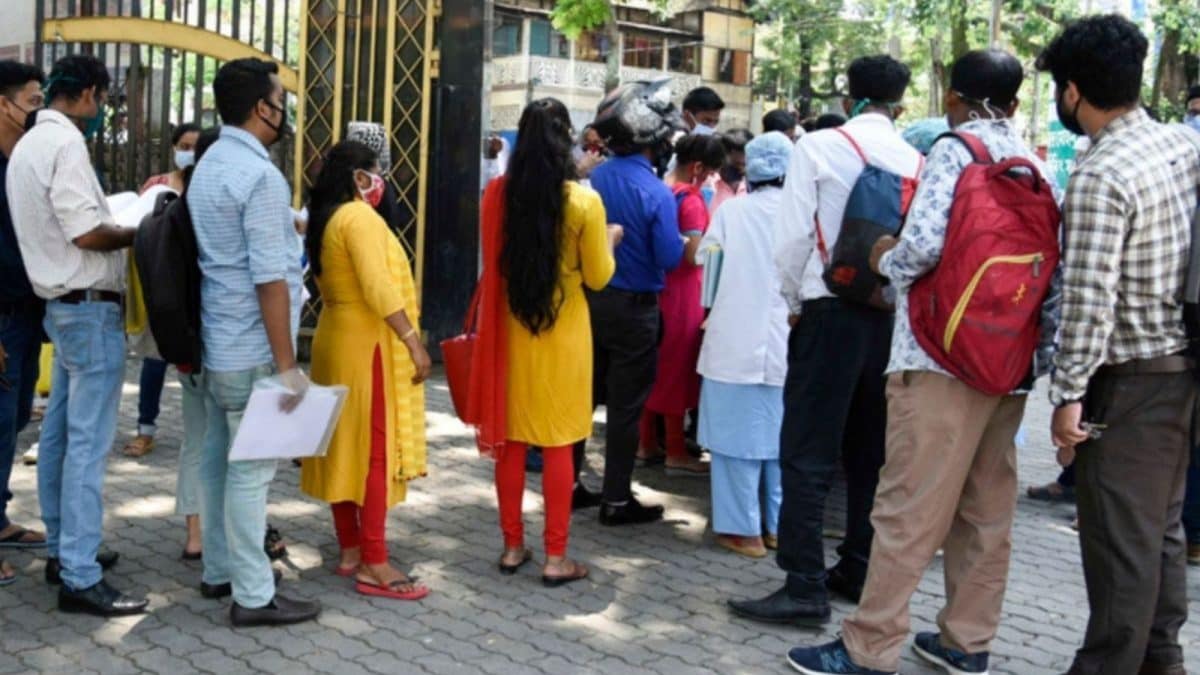
JEE Main 2025: The Session 2 exam is being held from April 2-9. (Image/PTI)
JEE Main 2025 Session Paper Analysis Day 2: The National Testing Agency (NTA) is conducting the Joint Entrance Examination (JEE) Main 2025 Session 2 for B.E./B.Tech and B.Arch & B Planning courses from April 2 to April 9. Today, April 3, 2025, the JEE Main 2025 Session 2 exam will continue for B.E./B.Tech courses, with two shifts. The first shift was held from 9:00 AM to 12:00 PM, and the second shift will be conducted from 3:00 PM to 6:00 PM.
JEE Main Session 2 Paper Analysis: Shift 1
The JEE Main paper held on 3rd April 2025 (morning shift) was rated as moderate in overall difficulty. Among the three sections, Chemistry ranged from easy to moderate, Physics was moderately challenging, and Mathematics was slightly more difficult. While the question distribution across topics was generally balanced, some chapters had greater emphasis, while others were missing entirely. Here’s a detailed subject-wise breakdown:
Physics
Most students found the Physics section moderate, with a strong presence of numerical questions. The topic distribution was fairly balanced, with significant weightage given to Mechanics, Electrostatics, Optics, and Units & Measurements. However, Modern Physics and Magnetism had fewer questions, and notably, EMI and AC chapters were not covered.
Also Read- JEE Main 2025 Session 2 Exam Analysis: Chemistry ‘Most Challenging’, Paper ‘Well-structured’ Than Session 1
Chemistry
The Chemistry section was rated easy to moderate. Almost all chapters were included, with Inorganic and Physical Chemistry carrying the most weight, while Organic Chemistry had fewer questions. Most theoretical questions were directly taken from NCERT, making them straightforward, although a few required extra time to solve.
Mathematics
Mathematics was moderate to difficult, with questions well-distributed across various topics. Key areas such as Matrices, 3D Geometry, Vectors, Conic Sections, Calculus, and Determinants were prominently featured. Some questions, however, were lengthy and time-consuming, adding to the challenge.
Based on student feedback, the difficulty level of the sections can be ranked as follows: Mathematics is the most difficult, followed by Physics, with Chemistry being the least challenging.
(With Inputs From Aakash Educational Services Limited )